|
2003-2004 SEASON
December 2003 Meeting – Annual Competitions
The December meeting was not only well attended but successful from the Society’s point of view because of the high level of participation in the annual competitions.
There were 19 entries, which was not only a healthy increase on previous years but resulted in some close results As in previous years, the entries were judged in another room during the auction and the results announced later. The auction attracted plenty of bidders and the traditional mince pies and sherry at the interval, which followed, was a very sociable occasion.
After the Interval judges Maurice Flack and John Grant announced their verdicts. The winners were
Traditional - John Davis - A Study of War Tax stamps of the British Empire
Postal History - Jean Ruskin - Inspectors’ Marks on pre-stamp era Great Britain covers
Thematic - Maurice Shorten - "Victor Hugo, his life and times "
Aerophilately - Stuart Henderson - Canadian Airmails.
The runners up were
Traditional - Christine Earle with the 1939 Swiss National Exhibition issue
Postal History - Michael Lawrence Goodman "Underpaid US Mail 1850's to 1900's"
Thematic - Sheila Foster "From Vine to Wine"
The judges praised the overall level of entries and said they had to make some difficult decisions. They received the usual vote of thanks.
The judging was followed by the presentation of the winners’ awards and also the presentation of the
2002 Johnson Literary Award to Michael Pitt-Payne for his article which appeared in the October2002 Stamp Lover entitled “Unpaid and Underpaid Mail in the UK 1838 to 1955”. After the presentations, members enjoyed the opportunity to views a selection of Michael Pitt-Payne’s collection relating to the article. This included some hard to find modern items such as used on cover specimens of the 1994 postage dues, which had such a short life in normal use.
The winners and runner up entries to in the competitions were also on display. There was such a diversity of material on show that most members lingered on to “closing time” in order to view it to their satisfaction.
November 2003 Meeting – The Postage Due System by Michael Furfie
Nearly 50 members assembled in the mezzanine room for Michael Furfie’s display on “The Postage Due System”. This was very well presented with a large number of covers and mail items supplemented by a display board, prepared with great care by Michael to illustrate the points he was making.
Firstly he explained what a Postage Due cover comprised and told us that every piece of mail on which a surcharge was being made was stamped with a Letter T (for Tax) to indicate that an appropriate sum was to be collected from the recipient.
Explaining the intricacies of gold centime calculations, throughout the display Michael took his audience through changing postage rates over a long period, how the fines were imposed and how they were collected. There was also information on the procedures for registered mail redirection rules, customs charges, the cash on delivery system and concealed messages on postcards.
The display was most appropriate at this time in view of the correspondence in “Stamp Lover” recently on the growth of Royal Mail’s handling charges when collecting Postage Due. Our sincere thanks to Michael for a most interesting display.
October 2003 Meeting – South Africa, Forerunners of the Union & the 2½d Union Issue of 1910 by Dr Christopher Board FRPSL
At the October meeting members were entertained by Dr Christopher Board who gave a display of early South African material The first part of the display covered the postal stationery cards of the Cape Good Hope, starting with the locally designed and printed penny postcards and following with the De La Rue printed cards. The various rate changes were shown, as were advert cards and both privately and officially illustrated cards. The second part of the display traced the 1910 commemorative stamp for the creation of the Union of South Africa from first proposals, through the design stage and colour trials, to the final issued stamp. The initial essays had the head of King Edward VII, but on his death this had to be changed to that of George V. Publicity material for the stamp was displayed and there were examples of usage on first day covers, on foreign mail, making up parcel rates and on registered envelopes.
The final section of the display covered the “inter-provincial” period immediately after the creation of the Union on 31st May 1910. During the period between this date and the issue of the first regular Union stamps in 1913, the stamps and postal stationery of the four former colonies could be used throughout the new Union Examples were shown from the period up to February 1911, at which time the stock of postal materials was centrally combined, the period from February to July 1911 when the central stock was redistributed as demand arose, and the period from July 1911 when, with stocks running out, old colonial material was reprinted by the Union government for use until the new Union stamps became available. There were also examples of late use, as the old colonial stamps were not finally demonetised until 1937. The vote of thanks for this most interesting and varied display was given by Brian Austin.
September 2003 Meeting – Cyprus by Christopher Cruttwell
“The best collection of its kind in the world with many unique items” is how Maurice Porter summed up the first display of the new season in his vote of thanks to Chris Cruttwell for his display of Cyprus. No one who saw arid studied what was on show on this warm September afternoon would disagree. The display covered the period 1878 to about 1958, i.e. from the beginnings of British rule. Members were treated to a display that was not only comprehensive, but selected to include some very unusual items. Chris said he decided to collect Cyprus daring his schoolboy days in the 1950’s after looking through a Gibbons and finding it had the most stamps which could be bought for half a crown or less!
Cyprus was ceded to Great Britain in June 1878 by the Turkish Empire and the following month a force under Admiral Lord John Hay landed. GB stamps were used at first, followed by overprinted GB stamps (from 1 April 1880), with the first key plate issue appearing in 1881. The Queen Victoria “key plate” issue is a complex one with different heads and shades. The display provided a real guide to the issue, including as it did the rare Crown CA in emerald green, and an extensive display of the surcharges. Postal history included correspondence relevant to the British acquisition of the island and prisoner of war mail from the First World War. Later items included mail from Jewish immigrants to Palestine interned in 1947/8 before the state of Israel was founded, mail censored during the 1956 Suez crisis and mail sent from Greek Cypriot leader Archbishop Makarios and his entourage whilst exiled in the Seychelles.
2002-2003 SEASON
July/August 2003
(The July Meeting comprised the Society's Annual General Meeting followed by a Grand Auction.
There was no Meeting during August)
June 2003 Meeting – The German Occupation of the Channel Islands by Gerald Marriner
At the June meeting, members were treated to a display by Mr Gerald Marriner on the German Occupation of the Channel Islands The display covered four main areas — the internal mail service, the German feldpost, mail to and from internees, and the Red Cross Message System.
The internal mail service after the occupation initially used existing stocks of British stamps, with the 2d stamps being bisected as stocks of the 1d ran out. Then, locally printed stamps - the Arms issue and later the Views - were used. All these were displayed, including commercially used bisects, the different printings and papers of the Arms issues and proofs of the Views stamps. There were also examples of mail from the smaller island of Sark and Alderney. Paper became scarce, and a handmade envelope was shown, as well as envelopes, which had been used twice (or in one case three times). As the stamps ran out “paid” handstamps were also used.
The German feldpost was used to send mail between the islands and Europe. A few (failed) attempts to get mail in and out via neutral countries were also shown. As well as the military mail, there were examples of civilian mail from various countries, including the only known cover from Argentina to Jersey during the occupation, an item from the concentration camp on Alderney to Paris and a radio message card.
The third section of the display comprised a fascinating group of items to and from internees - islanders of British descent were interned in 1942 - and the final section showed mail from the Red Cross Message System which connected the islanders with the UK and other allied countries. Examples shown included items from the United States, Canada, Ceylon, Rhodesia and Kenya. At the end of the display a vote of thanks for a most interesting afternoon was given by the President Major Pratt.
May 2003 Meeting – The Berlin Olympic Games 1936 by Anthony Bosworth
There are different types of display - some have good speakers and not so interesting material, whilst others have wonderful material but not such a good presentation. This month’s meeting “The Berlin Olympic Games 1936 was presented by Anthony Bosworth and the audience had the chance to see both unique material and hear an enthusiast speaker who knew his subject. Germany was turned down the chance to host the games in 1912 but was allocated 1916 Games, which were then cancelled because of the war.
It was not until 1926 that Germany was re-elected to the Olympic committee and she eventually hosted the 1936 games. This was a two-week festival, which had both political and philatelic influences. Three charity stamps were issued for the Winter Games at Garmisch-Partenkirchen together with various hand-stamps and post office slogans, and eight stamps inscribed Olympische Spiele 1936” and two miniature sheets were released for the Summer Games all showing the different sports or the torch bearer. There were 14 official hand-stamps and souvenir sheets. An Olympic bell was cast and a roller canceller with the bell motif produced.
It was explained how two organisers were removed from committees because of Jewish connections; Dr. Theodor Liwald was replaced by Hans Von Tschammer und Osten but this caused such an outcry from the USA that he was reinstated as an adviser. Captain Wolfgang Furstner was the person responsible for the Olympic city and he was replaced and given no recognition of his important contribution to the games.
The display had photographs showing the people concerned with the games and many postal items relating to the games; even a ticket to the closing dinner.
The NPS audience was supplied with a feast of information and material. In his vote of thanks, Ian Nutley remarked on the enthusiasm of Tony in his presentation and said we had all learnt something and been privileged to see some very scare items.
April 2003 Meeting – President’s Afternoon
The April meeting was listed as President’s Afternoon and a full house anticipated a fine display of China related material from our President Richard Pratt FRPSL. Members were not disappointed for Richard produced a fascinating selection of covers and stamps, which are just a small part of his collection from this distant land. The sector which he chose to show us was devoted to ‘Shanghai Local Posts in the Widest Sense”. This is just one of his specialities and he was able to show us much scarce material emanating from the second half of the nineteenth century. The expatriate postal service commenced around 1863 for the benefit of numerous foreign traders who were active in the vicinity of Shanghai. After more than an hour of explanation about this service, Richard invited us to take a closer look at the covers and memorabilia of this era displayed on the frames. A vote of thanks to our President for a most interesting afternoon was then proposed by Dane Garrod who was Chairman for the event and by Gregory W. K. Loh MBE.
March 2003 Meeting – Aspects of Czechoslovakia by Yvonne Wheatley
For the March meeting we were delighted to welcome Yvonne Wheatley who gave us a fascinating display, which she entitled Aspects of Czechoslovakia. Her collection includes pre-stamp covers and the first frame featured a cover dated 1644, but this of course bore no postal markings.
October 25th 1918 saw the formation of the Czechoslovakia and the events that followed were well represented in Yvonne’s display. In December of that year the first stamps were issued. Materials were in short supply so various face values were printed on the same sheet, with the main design comprising Prague castle. The next frame displayed the 1919 overprints and at this time citizens could exchange Austrian and Hungarian stamps for the new Czech stamps, which were also overprinted in 3 lines and sold at fifty per cent above face value, the surcharge being devoted to charity, but these stamps were not very popular.
It was at this time compulsory to serve in the Czech army and soldiers were sent to serve in Russia, some of whom had to escape to France where they formed their own force after an epic thousands of miles journey. Three ungummed and imperforate stamps were produced in Russia and when legionnaires returned to their homeland they took some of the stamps with them, where they were gummed and perforated. About 80,000 men of the Czech army went to Russia but when they returned their numbers were down to about 20,000. Postage dues and booklets with advertising on interleaving pages were also shown, plus Red Cross experimental issues. When Newspaper stamps were in short supply publishers prepared their own labels, but these were only in use for about 6 weeks.
Subsequent political history and changing borders created further interest for collectors and in 1938 German stamps were introduced when the Germans occupied the Sudetenland. The short life of the 1939 stamp issued for the inauguration of the Carpatho-Ukrainian Parliament that was overtaken by events was described, whilst in the post-war period, the display included material demonstrating the drastic effect of the currency revaluation on the cost of sending mail.
The vote of thanks was given by Michael Furnell who expressed the appreciation of all concerned display and his pleasure at having Yvonne with us to give this display.
February 2003 Meeting – The Quarantine and Disinfection of Mail by Denis Vandervelde
In February we were reminded of the plagues and problems that faced our forefathers and those in more recent times, when we were given a fascinating display entitled ”The Disinfection and Quarantine of Mail” by Denis Vandervelde. It featured a number of very well written up sheets showing covers and other items from his collection dating from the sixteenth century to 2002. Included were items relating to the Plague of London of 1666 and the cholera epidemic which hit Europe around 1831. There were many examples of attempts to disinfect by scorching or dipping mail in disinfectant at various European centres and we were given explanations of the many locations where quarantine regulations had to be strictly enforced.
An excellent afternoon’s display and one that again illustrated the fascinating and wide range of subjects embraced by philately.
January 2003 – Civil Censorship in the British Empire – World War II, by Christopher Miller
For our first meeting of 2003 we were pleased to welcome Christopher Miller, Hon. Secretary of the Civil Censorship Study Group.
His subject was Censorship of Civil Mail in the British Empire - World War II. He explained that the history of censorship goes back to the 19th century and was utilised to a considerable extent in World War I. In the Second World War censorship of civil mail started soon after the outbreak of hostilities in the autumn of 1939. The aim of civil censorship included the protection of economic interests, the study of the morale of the population and the prevention of the illegal export of currency.
We were shown many examples of censorship labels used to reseal letters that had been inspected and these had codes printed on then which indicated the country or territory where the censorship had been carried out. Examples of rubber stamp impressions used by various censorship offices were also shown. Nearly 200 sheets, all mounted with typical censored envelopes, were displayed and these originated from countries ranging from Antigua and Ascension to Zanzibar. Altogether a most comprehensive and interesting display.
December 2002 Meeting – Annual Competitions
The key attraction of the December meeting was the annual cup competitions, which this year were judged by Marjorie Wharton of Hastings and Eddie Weeks from Epsom/EweII. Their deliberations resulted in the following awards:
The Postal History Cup won by Jonathan Spooner for his display of Great Britain Postage Dues on incoming mail.
Michael Goodman won the Traditional Philately Cup for his 1837/61 3 cents USA perforated Washington Heads.
David Hunter was awarded the Thematic Cup for a display he entitled “The Scottish Enlightenment”
After the presentation of the Awards, the Judges made some helpful comments on the winning displays, which were much appreciated and a vote of thanks was given to them for the time and trouble they had taken over the judging.
The meeting concluded with a fascinating display of 1939/45 Wartime Christmas Airgraphs and Airletters by our Council Member Christine Earle.
November 2002 Meeting – Visit by The Channel Islands Specialists’ Society
For our November meeting we were treated three excellent displays by Andy Hinks, David Gurney and Lewis Elliott from the Channel Islands’ Specialists Society, who gave us information on the postal history of the Channel Islands. During the afternoon we were shown stamps, ship letters, boat mail, cancellations and sub-offices, including mail to French ports and a wealth of scarce material emanating from the island of Sark. A most interesting set of presentations and an indication of the wide range of philatelic interest that can be found in a group of relatively small islands.
October 2002 Meeting – Colombian Airmails by Eric Harris
Eric Harris gave us a most interesting display which he entitled “‘Colombian Airmails”. He reminded us that this South American country lies in the north of this continent, near Panama and has a coastline on both the Caribbean Sea and the South Atlantic Ocean. In the hinterland are the northern Andes, which provides extremely mountainous terrain with fertile river va1leys where valuable export crops are grown.
The capital Bogotá is located inland and communications with the coast was formerly by railways and boat. The first part of the display was devoted to the train services which formerly provided communication with the coastal towns and ports. As long ago as 1921 a French company was given a licence to establish the first scheduled air service, which did not prove very satisfactory.
However, in 1923 an airline SCADTA agreed with the government to provide air services for the conveyance of mail with a daily service. It now became possible to transmit mail from the Bogotá to the coast in 70 minutes compared with 4 days in boats by the river service. The arrangements for the mail collection and delivery of mail using the services operated by the Company were explained, with an extensive display of material showing the way in which such covers would bear stamps issued by both the air line and the government post office. Having demonstrated the developments of the 1920’s and 1930’s this fine display concluded with the events associated with the eventual American takeover of the airline.
September 2002 Meeting – Morocco (Up to Independence) by Bob Deakin FRPSL
This Season’s programme commenced with a display by Bob Deakin FRPSL, entitled Morocco Up to Independence in 1956. He told us that this North African country was not collected by many philatelists, but it was full of interest. The Kingdom of Morocco on the northwest coast of Africa has a population of about 25 million people, most of who are Moslems, but with Christian and Jewish minorities. About one-third of the land comprises the Atlas Mountains, which reach to more than 13,000 feet above sea level, and the total area of the country comprises nearly 275,000 square miles. Between the Atlas and Atlantic coastal strip there is an area of high plateau, bordered by the Sahara Desert in the South. There is a Mediterranean climate and vegetation in the North, while the west facing slopes of the Atlas are thickly forested and have a high rainfall. The country has the world’s largest deposits of phosphates.
Initially private posts were set up and we were given an excellent display of the stamps issued by these various posts. The first British Post Office was established in 1857, this was in the British Consulate at Tangier. The system was extended to other towns including Casablanca and Rabat. Initially the post was under the control of the Gibraltar Post Office, whose stamps were used to pre-pay postage. Later British stamps and postal stationery were used, and from 1898 Gibraltar stamps were overprinted “Morocco Agencies”. France established a Post Office at Tangier in the 1850s and produced special stamps in 1891 comprising the French Peace and Commerce (SAGE) type surcharged in centimos and pesetas.
The Spanish had a long interest in Morocco and opened a Post Office in their Tangier consulate in 1865. In 1903 stamps of Spain were overprinted “Correo Espano-Marruecos’. Morocco was divided into French and Spanish zones in 1909 and three years later separate Spanish and French protectorates were set-up.
Bob gave us much other interesting information about this little known but fascinating territory, not least the conditions that prevailed in the interior in the nineteenth and much of the twentieth centuries and the history of the Spanish enclave of Ifni. In giving a hearty vote of thanks for an unusual but informative display Michael Furnell briefly described his own visits to North Africa, while on Naval service in 1943 when he was based in Algiers and his 1951 visit to Casablanca on a cruise.
2001-2002 SEASON
July/August 2002
(The July Meeting comprised the Society's Annual General Meeting followed by a Grand Auction. As usual there was no Meeting during August)
June 2002 Meeting - Visit by members of the Brighton & Hove Philatelic Society
At this meeting we were entertained by a visit from The Brighton & Hove Philatelic Society, represented by their President, Graham Childs, their Vice President, Ron Shelley and Past-President, Richard West. In the unavoidable absence of our President, Frank Jones, Richard, wearing his NPS hat, introduced the visiting Society and mentioned the links between the Brighton & Hove and the Junior Philatelic Society, the former name of the National. The Brighton branch of the JPS later took independence and has since become a thriving society with many philatelic luminaries.
Graham Childs had visited the National in January of this year and his return was most welcome. He began by showing original documentation from the early days of Brighton & Hove, as well as his badge of office, The President’s Badge, which he was correctly wearing. Interestingly, this showed that JPS had been painted out from the Badge after the Brighton & Hove became independent. Graham then showed specimens from the Switzerland portion of Harmers’ Forgery Collection, including some rare sheets with numerous different cancellations ready installed thereon. Shades of “What postmark do you want? Come back this afternoon!” The total value if genuine would have been £Millions, but as they are, who can say?
During his time over many years with Stamp Magazine as the main editor, Richard West had occasional opportunity to visit far away islands, and he showed covers and photographs from his two trips to Bermuda where he had photographed every Post Office and sent registered mail from each site. As the Postmaster of Bermuda was by his side, the mail was correctly despatched through the system rather than handed to him... as if ever! Richard concluded with various island issues that had been changed due to errors and omissions, such as the inclusion of an island in an island group on a map, when the island belonged to another group - thankfully this was realised before issue.
For the second half Ron Shelley, renowned for his expertise on Spain, enlightened us with a display covering some interesting items, including the good work undertaken by King Alfonso XIII during the Second World War, when he had employed 40 staff to assist in the location of French and Russian Prisoners of War. Exceptionally this had been extended to a British citizen on one occasion, and Ron showed this interesting correspondence and information.
The thanks of the National and the audience, in particular, were given by Chris Earle to the invited guests for their displays.
May 2002 Meeting – Great Britain Postal Reforms by James Grimwood-Taylor
James Grimwood-Taylor of Cavendish Philatelic Auctions, Derby gave us a superb display at our 11th May meeting. This commenced with some very early letters from the middle of the 15th century when, with no official postal service, a Merchant postal system existed. This was followed by examples of early English letters sent by a system operated by Hostelries and Public Houses. These tended to be a bit grubby and beer stained!
Later a Royal Mail service was established, but few letters were sent due to the high cost of transit. Around the 17th century there were problems, such as the Civil War, the Plague and the Great Fire of London, which caused delays in the development of a reliable mail service. Facilities were improved towards the end of the 17th century when William Docwra opened offices for the receipt of mail in London and the numerous collection stations accepted letters for delivery at the cost of one penny. This low price made the scheme successful and it made a profit, so the Government look it over and also put a scheme for a half penny carriage out of business.
The problems of collecting postage from recipients and the high rates for postage on mail to overseas destinations were discussed and samples displayed. Much data was given about the need for cheaper postage and Rowland Hill’s Post Office reforms, which led up to the introduction of Penny Post and prepayment of postage by the sender. Part 2 of the display included envelopes for Members of the Houses of Lords and Commons, which gave free postage. An attractive Penny Black on a first day cover was displayed and James told us that he estimated there were only about 35 of these first day covers in existence as it is believed that initially the Penny Black was only available on 6th May 1840 at a few Post Offices, mainly in London, Liverpool and Manchester. Rowland Hill’s activities until he retired in 1865 were then covered and there was information about the Circular Delivery Co, which undertook mass delivery of what we would now call “Junk” mail, for a very low price, but whose scheme was closed down at the insistence of Royal Mail.
This fascinating display concluded with the launch of the Post Card and an l898 Imperial Penny Postage Christmas Day cover. Frank Jones, our President, gave a hearty vote of thanks to James Grimwood Taylor, for showing us so much interesting material.
April 2002 Meeting – President’s Afternoon
Due to an indisposition, our President Frank Jones was unable to give his annual President’s display on 13th April. His place was taken, at short notice, by our Vice-President Richard (Dickie) Pratt, an expert on China, who gave us an absorbing display on the Foreign Post Offices in China.
He told us that in the nineteenth century international trade with China was expanding with ships were terminating there from around the world. As there was no efficient local international postal system, some European countries, including Britain, plus the USA, Russia and Japan, established their own Post Offices. We were shown a wide selection of covers that had been despatched or received through these offices, plus a number official Postal Notices dealing with the services.
The second half of the display was devoted mainly to other Post Offices in China where there were mail services including Hong Kong, Amoy and Canton. There were examples of British soldiers and sailors mail from China to the UK, including the Maritime Mail service whereby soldiers and seaman in operational units were granted a special one-penny rate on letters to the U.K., whereas Officers had to pay six pence for a letter
March 2002 Meeting – Waterfalls of the World (with Postal Stationery) by Dr Jean Alexander
FRPSL.
On Saturday 9th March we welcomed Dr Jean Alexander FRPSL who entertained us with her fascinating display of Waterfalls of the World. Jean commenced by telling us that she started to collect stamps at the age of 11. She was keen initially on stamps which illustrated flowers, but her father thought she would find more interest in stamps and stationery depicting waterfalls She needed a plan to get started and thought of examining the heights of different waterfalls, but this dimension varies so much in various parts of the world, that she felt it was not a good idea; so she undertook some specialised study and discovered that waterfalls covered a vast range of subjects, worldwide.
Pages front her albums included stamps depicting some of the waterfalls of Europe, North and South America, Asia, Africa and Australasia. Other subjects included history relating to water, water in art, literature and music, medicinal spas, sport, tourism and leisure, hydro-electric plants, a tour of world water, statistics on waterfalls with the highest, widest and most prolific flow of water and those forming boundaries between countries. There were even examples of ‘personalised” stamps depicting waterfalls. Famous world personalities in connection with waterfall stamps were also included.
After an interval when the audience had the opportunity to inspect the many fascinating stamps, Jean presented the second hail of her display devoted to Postal Stationery depicting waterfalls, on airletters, letter cards, registered envelopes and postcards and here again a wide variety of material was available for our inspection. At the end of the meeting Brian Austin proposed a vole of thanks to Jean for her fine display.
February 2002 Meeting – The Philately of War, to about 1815 by Professor Barry Jay, FRPSL
At our 9th February meeting we were delighted to welcome Prof. Barry Jay FRPSL, a past President of the “Royal” who gave us a most interesting display entitled “The Philately of War to about 1815”. Material from campaigns of all description was shown. The first part was devoted to a period from early in the 15th century, when most countries did not have a comprehensive postal system so it was necessary to depend manly on messenger services. The second half of the display dealt mainly with mail across the Channel between 1793 and 1815 and the impact of the Napoleonic Wars. In all a most interesting and impressive afternoon.
January 2002 Meeting – The Harmer Reference collection of forgeries presented by Graham Childs
The meetings programme for the New Year started very well with a bumper attendance of members and an exceptional display. Graham told us that the auctioneering firm was started by the late Cyril Harmer, towards the end of the nineteenth century. The first sale in Bond Street was held in 1918 and comprised British War Stamps of World War I, realising a total of £1350.
In order to give a satisfactory service to vendors and purchasers Cyril Harmer stared to build-up a forgery collection for reference purposes and today this now occupies some 60 volumes covering the world. It is essentially a working collection and is constantly referred to by members of Harmer’s staff when preparing clients collections and accumulation for inclusion in Harmer auctions.
In addition to actual stamps and covers there is an extensive philatelic reference library with volumes such as Madam Joseph’s book of forged postmarks. The work of well-known forgers such as Fournier and Spiro are well represented in the collection in addition to items from less well-known forgers.
Only a small selection of items from the Forgery Collection could be included in the display, but those of special interest included Cape of Good Hope Triangulars, Mafeking Baden Powell forgeries and overprints; four pages of Ceylon classics, India first issue, mini-sheets and imperforates from the Ionian Islands, Post Office Mauritius, Newfoundland, New Zealand Chalon Heads and the Western Australia Inverted Swan. From Great Britain there were forgeries of the £5 orange, embossed issues 1841 2d bisect and, of course the famous Stock Exchange forgeries.
Altogether a fascinating display and we were all very grateful to Graham for his valuable time to show us this display.
December 2001 Meeting - Annual Competitions
In the absence of Frank Jones our President and his wife Judith, due to illness, our Vice-President Major Richard Pratt welcomed nearly 50 members present at our Christmas meeting held on Saturday 8th December. He announced that our Annual Competitions, arranged by Ian Nutley, the Competitions Officer, had attracted an excellent number of entries and these were being judged by the two independent adjudicators on the third floor, whilst members took part in the Auction or enjoyed facilities of the Library. Prior to the Auction however, Michael Furnell, Editor of Stamp Lover, was pleased to present the annual Johnson Literary Award to Stuart Henderson as author of the most popular article published in 2000.
The assembled company then adjourned to the ground floor for festive refreshments, which included mince pies, shortbread biscuits and sherry, and at 3pm the competition judges were ready to give us the results of their deliberations. After returning to the mezzanine floor,
Vice-President, Ian Nutley introduced us to the competition judges who were Ralph Grove and Peter O’Keeffe, both members of the Sevenoaks Philatelic Society and the Kent Federation. The judges told us that it had taken them 4 hours to undertake their task, for the entries were of a high standard, and in some cases there was only 1 point difference between entries. They considered that the quality of items displayed was superb and there was plenty of variety.
There were four classes and the winners were
Aero Philately
| 1st |
Christine Earle |
Transatlantic Airmails 1939 to 1944 |
| 2nd |
Ian Nutley |
Graff Zeppelin Egypt flights 1931 |
| 3rd |
Stuart Henderson |
Canada Semi Official Airmails |
Postal History
| 1st |
Ian Nutley
|
Auschwitz Postal History
|
| 2nd |
Keith Johnson
|
Postal History of Lincoln City
|
| 3rd |
Keith Tranmer
|
Postmarks of Herzegovina
|
Thematics
| 1st |
David Hunter
|
History of Sugar
|
| 2nd |
Christine Earle
|
ABC of Sport
|
| 3rd |
Stuart Henderson
|
Legacy of World War I
|
Traditional
| 1st |
Ian Nutley
|
Second World War Forgeries of France
|
| 2nd |
Stuart Henderson
|
Netherlands Precancels 1S76 to 1893
|
| 3rd |
Mike Goodman
|
The USA Imperf. Washington 3c.
|
After the cups had been presented, the Judges were thanked most sincerely for all their work and the assembled company was then able to enjoy inspecting all the excellent entries.
November 2001 Meeting – The rise and fall of National Socialism in Danzig by P G H du Boulay
For our November meeting held on the 10th of the month we were heated to an outstanding display by Giles du Boulay, comprising over 200 sheets of his material which traced “The Rise & Fall of National Socialism in Danzig”.
First he reminded us that Danzig, was a Baltic seaport with a population of about 350,000 inhabitants which was established as a free state in 1920 under the protection of The League of Nations. Initially German stamps were overprinted “Danzig”, but in 1921 a set of ten rouletted stamps, depicting a Hanseatic Trading Ship were issued, which incorporated the words Freie Stadt Danzig. Thereafter several other sets bearing the Danzig Coat of Arms were issued.
After Hitler came to power in Germany and gradually his influence spread to Danzig and Jewish citizens were harassed. Hitler was made a freeman of Danzig in 1939 and the Free State was incorporated into Germany. When World War II broke out the SS rounded up many people opposed to Germanisation, but initially life went on much as usual as Danzig was a bit of a backwater. However censorship of mail was imposed and from 1942 there were a number of air raids by the RAF, as the city had become a centre for the construction and assembly of U-boats. The 1925-1939 issues of Danzig stamps were overprinted “Deutsches Reich” and were valid throughout Germany.
The display by Giles included Navy, Army and SS cards and other material including U-Boat Permit Stamps, plus leaflets dropped by the RAF, urging German troops to surrender. In January 1945, the Russians launched their great invasion of Poland and Eastern Germany and Hitler decreed that Danzig should be defended to the last cartridge. In March 1945, leaflets were dropped urging the Germans to surrender and on 30th March a surrender was achieved. Danzig became a Polish province in 1945.
At the end of the display, Dane Garrod proposed a vote of thanks to Giles for a display that was a complete Social History of the territory as well as a fascinating philatelic treat.
October 2001 Meeting- 100 Years of French Aviation by John Hammonds
John began his display be reminding us that the idea of human flight was as old as humanity itself, from Greek mythology, “Homo Volens” who threw himself off the top of a tower in front of the Emperor Constantine, balloon flights and so to the flights of the Wright Brothers and Bleriot. Following Wilbur Wright’s visit to France and Bleriot’s flight across the Channel, interest in flying increased. The period 1909-1914 saw a considerable number of Aviation Meetings marked by souvenir programmes, vignettes, postcards and special postmarks, which were duly displayed, as material marking various Air races held in 1910-1913.
Following the end of World War I various experimental or test flights took place which were duly represented in the Display, followed by four frames of material devoted to the various companies operating from France between between 1919 and 1933, most of whom merged in 1933 to form Air France, (Frames 8 and 9) which accepted responsibility for all the routes originally operated by the constituent firms. Frames 10 and 11 showed the development of air activities in Africa in the 1930’s and the various internal and experimental services between 1919 and 1939.
Devoted to the post 1945 era, frame 12 showed the Late 631 design, a large transatlantic flying boat ordered in 1936, which made a maiden flight in 1942, but was destroyed by bombing in 1944 at Lake Constance. Eight flying boats were eventually produced and used on the Bordeaux to West Indies route, which was inaugurated in August 1947, eventually ending up operating in West Africa. Finally Concorde items were shown including examples of labels used for Concorde at the Paris Salon International Aeronautique and the first postmark showing Concorde and dated 1963.
September 2001 Meeting - Classic Stamps by Alex Johnson
After the large auction sale and viewing of the Literature Postal Auction, we welcomed Alex Johnson to give his display of Classic Stamps. He commenced by telling us that he started collecting when he was 8 years old and whilst he is still a keen collector “I am nothing like as fanatical as I was in my early years. My collection of ‘classic stamps’ has been built up over the past 35 years and my interest lies principally in the stamps themselves, rather than in postal history aspects. Collecting some 30 countries, I would regard myself as a general collector, although I do have favourite countries, resulting in a degree of specialisation within that group. Above all, I am finicky about condition and try not to acquire anything which is not regarded as fine”.
The display given to the NPS was drawn from 24 countries and comprised pages selected for their eye appeal, showing, where possible, multiples. The first half of the display concentrated on those countries which adopted one of the various profile heads of Queen Victoria, ranging from that used on GB’s Penny Black to those of St.Vincent, St. Helena, Ceylon and Australian States. A notable item was an 1887 cover from New South Wales bearing three copies of the ‘square diadem’ 8d orange and addressed to CHARTERHOUSE STREET.
The display continued after the interval with countries that chose designs based on the Chalon portrait followed by those who selected designs which did not feature the Queen e.g. Cape Triangulars, Barbadian Britannias, Western Australian Swans and Newfoundland Pence issues. The latter were extensively forged, some of which were included in the display. The afternoon concluded with a continental flavour, being devoted to the classic stamps of Belgium, Luxembourg and the Netherlands.
2000-2001 SEASON
July/August 2001
(The July Meeting comprised the Society's Annual General Meeting followed by the Stamp and Literature Auctions. As usual there was no Meeting during August)
June 2001 Meeting
This meeting coincided with the NPS Visit to BELGICA 2001 and took the form of Displays given by Members of the Society
May 2001 Meeting - Visit by members of the Great
Britain Philatelic Society
For our first Summer meeting we had the pleasure of welcoming three prominent
members of the GB. Philatelic Society, who gave us very interesting displays as
follows:-
Phil Kenton - Mail By 'British' to and from Latin America 1800 - 1880
Leslie Wilkinson - What I do not Collect and What I do Collect
Michael Sefi - The King George V Downey Heads
The three displays were full of interest and very well presented. We are most
grateful to all three speakers for sparing the time to come and entertain us in
such a memorable way.
April 2001 Meeting - President's Display
On the second Saturday in April we were entertained by our President Frank
Jones, by a display as a means of showing members the attractions of studying
the Postal History of the Air and he produced hundreds of examples from his
collection of Aerophilately, to which he has been devoted for very many years.
He started with examples of the pioneer 1911 London to Windsor flights,
followed by the Daily Mail newspaper's efforts to encourage the movement of
mail by air.
The establishment of services to Europe were interrupted by the outbreak of
World War II, but before the end of this war plans were being made to design
Air Mail Labels so as to distinguish letters on which additional postage had
been paid for dispatch by air. These labels were adopted by France in 1918 and
Great Britain in 1920, and eventually they were used almost worldwide, with
only minor local variations. A recently acquired cover sent to Denmark on 15th
September 1920 by our founder Fred Melville opened up a new line of enquiry
about Fred's many activities and we hope to publish more information on this,
after careful research has been completed.
In the late 1920's and 1930's aircraft were often designed to carry freight in
preference to passengers and Imperial Airways pioneered the early mail services
to South Africa which were later extended to India, Australia and New Zealand,
aided by the Empire Airmail Scheme.
Frank went on to remind us that in 1930 Blue Airmail Letter boxes were
introduced by the British Post Office and showed us some crash-mail together
with scarce Green airmail labels introduced by Malta. The problems of 1939/45
wartime airmails were discussed, including the introduction of new means of
handling mail to servicemen serving overseas. That this most interesting
display was enjoyed by everyone present was evident by the loud volume of
applause at the end of the 80 minute talk and we thank Frank most sincerely for
all his efforts to entertain us.
March 2001 Meeting - German East Africa 1914-1917 by
Michael Farrant FRPSL
The display following the auction was by Michael Farrant FRPSL whose subject
was German Posts in East Africa 1914 - 1917. This traced the effects of the
First World War on the mails from this German Colony, which at the time had
been established for less than a quarter of a century. News of the conflict
reached the colony during the night of 3rd-4th August 1914 and the main effect
at the tune was the cessation of mail services both in and out of the colony.
The territory was cut off from the Fatherland immediately by the activity of
the British Navy which imposed a blockade off the East African coast and all
German merchant ships were captured or interned in neutral ports. The small
German cruiser 'Konigsberg" which was in the area appeared to be a threat
as a commerce raider, but had little success and was destroyed in July 1915.
The Allies did not launch a campaign to capture the German colony until March
1916, when British troops entered the territory from the north while Belgium
and other mixed forces invaded from the north and south west. The main German
Defence Force comprised about 3000 white soldiers and l0,000 askaris, but the
Allies needed more than 300,000 men to conquer the territory.
The philatelic display included many interesting items including Internment
Camps, cash frankings, emergency year dates for "15" and
"16", prepaid envelope, Konigsberg and Wuga provisionals, also
Feldpoststations. A guerrilla force proved a nuisance, but a surrender was
arranged in Northern Rhodesia on 14th November 1918, after it had been chased
by British forces throughout Portuguese East Africa into the former German East
Africa. At the end of the display our President Frank Jones thanked Michael
Farrant for a superb display which he thought was one of the best examples of
postal history which we have seen recently'
February 2001 Meeting - St. Helena and Boer War POW
Mail by R C Deakin, FRPSL
On 10th February a well-attended meeting was treated to a fascinating display
by Bob Deakin FRPSL, entitled "St Helena and Boer War POW Mail".
Before the display we were given a brief outline of the history and geography
of St Helena, a remote volcanic island in the South Atlantic discovered by the
Portuguese in 1502 and taken over by the British in 1659. Its most famous
inhabitant was Napoleon, who was exiled there in 1815 and guarded by 3,000
troops and a naval detachment until he died in 1821. The first half of the
wide-ranging display comprehensively covered the stamps and postal history of
the island from the pre-stamp period through to Queen Elizabeth, one of the
earliest items being an entire from 1827 sent to Guernsey.
The first stamps were issued in 1856 and the same plate was used for the next
40 years, first by Perkins Bacon, and then by De La Rue who surcharged the
stamps when postal rates changed. A range of the distinctive St Helena cork
cancels were shown - the stamps were invariably cancelled by these, with the
datestamp being struck separately on the letter. Photographs and letters
connected with a lesser-known exile were also on view. After the Zulu wars,
Dinuzulu, son of the former Zulu Chief, Cetewayo, was exiled to St Helena for
eight years. Of the more modern material, the star item was perhaps the 1961
overprinted Tristan Relief set, of which only 434 sets were sold before the
Colonial Office ordered their withdrawal as being an unauthorised issue.
The second part of this display was dedicated to the Boer prisoners of war
lodged on the island, together with censored mail from World War I and also
World War II, during which the island was allocated the censor code 'VV'. On
the outbreak of the South African War in 1899 Boer prisoners were incarcerated
in two camps, Deadwood and Broadbottom. Amongst the prisoners was General
Cronje, and letters and documents written by him were seen. A wide variety of
mail from prisoners was shown, including some charming hand-painted postcards.
Many countries sided with the Boers against Britain, and mail to and from
Scandinavia, Germany, France, Holland and Portugal was represented. The
wonderful quality of this display, and Bob's informative and at times amusing
commentary was borne out by the number of members who stayed long after normal
time to chat to our guest and continue looking at this amazing material. A vote
of thanks by Allan Boyce formalised our sincere thanks to Bob for a most
memorable afternoon.
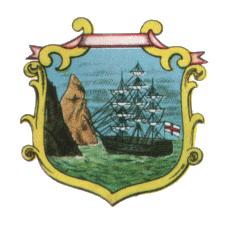
BY WAY OF A POSTSCRIPT, after learning of this Display, one of our long
established members who lives in Devon, wrote in to say that he was reminded
that his Mother was brought up on St Helena as a young girl and did not leave
the island until 1910 when she married an employee of the local Telegraph
Company. Later the family returned to St Helena and our correspondent recalls
his wonderful childhood on the island, with his sister, when he was between the
ages of 3 and 7 years. Then there were no cars, no TV, no schools, no predators
and the children were able to roam the island on their donkeys in complete
safety, for the Islanders were a delightful people.
 |
Our correspondent then went on to tell us that
his maternal grandfather owned some property on St Helena and in one of his
fields Boer War Prisoners of War were camped in tents at the turn of the
century, during their period of incarceration. They were not confined, as there
was nowhere to escape to! However, one evening they killed and ate his
Grandfather's entire flock of peacocks, and all that remained, next day, was a
collection of peacock heads and necks, strewn over the lawns! |
January 2001 Meeting- "On Dragons' Wings" by
Brian Asquith
For the first meeting of the New Year we were delighted to welcome as our
speaker Brian Asquith, the international philatelist and gold medal winner.
 |
The title of his display "On Dragons
Wings" was intriguing, but he soon told us that he had been involved in
aviation nearly all his life and in the 1970's he collected Concorde items, but
then decided he wanted to form a collection that was different and chose
Airmails of China. The title of his display refers to the Dragons wings which
appear on Chinese Banknotes and on the first airmail stamps of China.
|
He then proceeded to display a whole host of interesting items and covers
dating back to the Boxer Rebellion of 1901, plus examples of the 1920's, when
Handley Page aircraft were used for transportation. He also produced many other
interesting items. Major Richard Pratt gave the vote of thanks
December 2000 Meeting- Annual Competitions
The last meeting of the year is always devoted to the NPS Annual Competitions
and our Competitions Officer, Ian Nutley was delighted with the response from
members, which exceeded last year's number of entries. The two excellent
accredited judges, namely Dr P.G.E. Reid of Bracknell, Berkshire and Mr Len
Stacey from Essex, enjoyed their task and before the results were announced,
the Judges' Report was given by Dr Reid, which proved helpful to the
competitors.
The winners of the Trophies were:-
Traditional Philately Mike Goodman for his
entry, USA1853- 1860 3c. Nesbit Stationery
Postal History Keith Tranmer for Turkish
Field Post Offices, Dardanelles and Gallipoli
Aerophilately Derrick Pillage for US
Government Air Mails.
Thematic Steve Boorn for The Origins of
Cardiac Care.
The first part of the meeting was devoted to the monthly auction and there were
nearly 30 members present in the auction room, with some spirited bidding for
many of the 400 or so lots. After the auction, Michael Furnell, Editor, Stamp
Lover, presented the Johnson Literary Award to Ian Nutley for the best article
(The Mermoz Line) published in the magazine during 1999.
In the unavoidable absence of our President Frank Jones, the Vice-President
Major Richard Pratt then invited everyone present to join him in partaking of
Christmas style refreshments before the competition results were announced.
November 2000 Meeting - The Annexation of Austria 1938
by Ian Nutley
Due to family bereavement, our scheduled speaker was regrettably unable to
attend the meeting, but at short notice, our Programme Secretary stepped into
the breach and gave us a superb display devoted to the German annexation of
Austria in 1938. The article entitled "The Plebiscite That Never Was"
featured in the February 2001 issue of Stamp Lover, describes part of the
display. On its conclusion, Allan Boyce gave our speaker a hearty vote of
thanks for a most interesting talk, very well presented.
October 2000 Meeting - Kent Postal History by Maurice
Porter
Our President, Frank Jones introduced us to Maurice Porter, who gave us a most
entertaining display, which he called "Kent Postal History" He was
accompanied by two very knowledgeable guests, namely Patrick Frost and Andrew
Norris. The highlight of this collection was the diversity of subjects covered.
For example, the 4th annual Philatelic Congress, was held from the 1st to 4th
May 1912 at the Queen's Highcliffe Hotel, Cliftonville, Margate, Kent and
Maurice was able to show us a wonderful collection of memorabilia including
photos of the hotel, dinner menus, special hotel stamps (labels), complimentary
tickets for various events in the town and articles. A feature, which created
much interest at the hotel, included working printing machines, one of which
was operated by our own Fred Melville.
An important part of the display was devoted to Kent railway services and a
quaint "ticket" was produced for a journey between New Romney and
Dungeness, where the fee of one shilling was paid with a dog ticket, platform
ticket and a bicycle ticket! In the early part of the last century,
Cross-channel travel to and from various Kentish ports was the subject of
intense rivalry between various operating shipping companies and there was a
variety of material which emphasised this.
Displays of tax markings on covers also proved interesting, and other items
shown, which Maurice described as "Just things that I like", included
advertising envelopes, disinfected ship letters to Kentish addresses which had
been sprinkled with vinegar and had holes punched in them, and early
information about a variety of small towns in Kent and their original post
offices.
Much of the material in this display had not been exhibited previously and must
have taken Maurice much time and patience to acquire. This was a most
entertaining display which was a great pleasure to view.
September 2000 Meeting - Displays by Members of the
France & Colonies Philatelic Society
Our guests for this meeting were members of the French & Colonies
Philatelic Society and four of their members kindly presented displays on
various aspects depicting philately from France and her Colonies, with a good
cross-section of material.
David Bromley produced a fascinating selection of philatelic items devoted to
the famous "Sower" series of stamps. He was followed by Barbara
Priddy (who is also a member of the NPS) who displayed a most interested
selection of items connected with the French Airmail services to North Africa
and South America, including the first flight across the Atlantic in 1927.
This display was followed by an interesting range of sheets devoted to the well
known "Marianne" stamps presented by Mick Bister and finally Derek
Richardson entertained us with Anti-T.B. vignettes.
|